By Mike Kocsis | 10 minutes read | Last updated: November 7, 2026 Categories: Uncategorized
Medically Reviewed by Dr. George Touliatos
Gone are the days when bariatric surgery and endless dieting were the only ways of shedding extra pounds. Today, peptides for weight loss are gaining attention as a more effective, promising approach to weight management.
Weight loss peptides are short chains of amino acids – the building blocks of proteins. They come in different chemical formulations and work through different mechanisms, with most mimicking naturally occurring gut hormones.
These peptides help you reduce your hunger and cravings without having to constantly force yourself to eat less, as is often the case with conventional methods.
This guide explains all that you need to know about weight loss peptide medications, including their types, benefits, risks, safety and more.
Meet Our Doctors
Meet our Doctors


What are peptides for weight loss?
There are over 7000 peptides your body produces to regulate multiple processes. Of these, some are called weight regulation peptides because of their role in controlling appetite, stomach emptying, food cravings and blood sugar levels.
Scientists have developed various synthetic weight loss peptides that are actually copies of these naturally occurring peptides. They activate different signalling pathways in the body, just like natural peptides do.
In the UK, three peptides are currently authorised specifically for weight management:
- Semaglutide (brand name Wegovy)
- Tirzepatide (brand name Mounjaro)
- Liraglutide (brand name Saxenda)
Important: Many unregulated fat loss peptides are being sold on the internet and people often confuse them with licensed products. Such products are unlicensed and have little to no evidence to back their claims.
It’s important to learn the difference between licensed and unlicensed products before exploring weight loss options.
| Type of weight loss products | Example | UK regulatory status |
| Weight loss peptides | Wegovy, Mounjaro, Saxenda | MHRA-authorised |
| Research peptides | AOD-9604, CJC-1295, Ipamorelin | Not MHRA-authorised |
| Weight loss supplements | Green tea extract, glucomannan, raspberry ketones | Regulated as food supplements, not MHRA-authorised medicines |
| Unregulated weight loss injections | Products falsely sold as weight loss medications | Not MHRA-authorised |
Do peptides help you lose weight?
Yes, they do. Licensed peptides for weight loss have been extensively studied through large-scale human clinical trials, which have shown positive results and proven their effectiveness in helping people lose weight.
Liraglutide (Saxenda): According to its 56-week long trial, participants taking 3 mg liraglutide once daily experienced an average weight reduction of 8%, compared with 2.6% in the placebo group.
Semaglutide (Wegovy): Its trials show that participants receiving semaglutide lost an average of 14.9% of their starting body weight over 68 weeks, compared with 2.4% among those receiving a placebo.
Tirzepatide (Mounjaro): Studies demonstrate that participants receiving 5 mg, 10 mg and 15 mg tirzepatide weekly injections lost an average of 15%, 19.5% and 20.9% of their initial body weight, respectively, compared to 3.1% with placebo.
The amount of weight loss varies between medications and individuals. Still, all three medications produced greater weight loss than placebo in trials.
How do peptides work for weight loss?
Here is how different types of peptides work:
GLP-1 receptor agonists
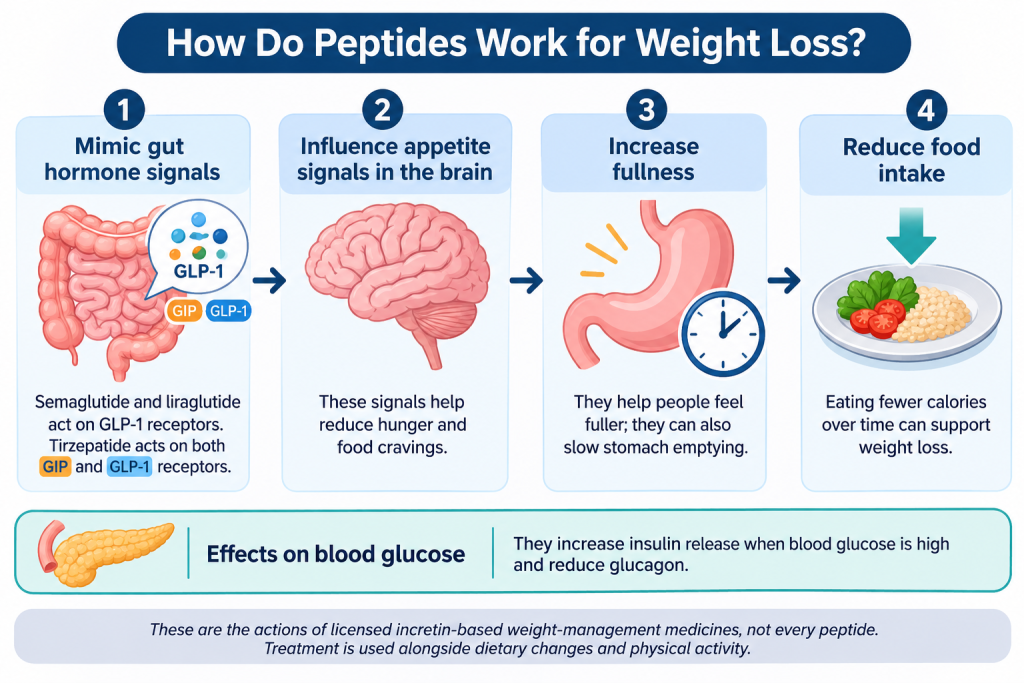
Liraglutide and semaglutide are glucagon-like peptide-1 receptor agonists (GLP-1 agonists). An agonist is a substance that activates receptors to produce a biological response.
In other words, a GLP-1 agonist is a medication that activates receptors of GLP-1 hormone that your body naturally produces when food enters the stomach.
So, when you take a GLP-1 agonist, it activates GLP-1 receptors that send signals to the brain to reduce the need to eat more and register fullness. It works for weight loss by:
- Slowing down gastric emptying.
- Producing a satiety effect, reducing hunger and naturally lowering calorie intake.
- Increasing insulin secretion and reducing glucagon release when blood glucose is high.
GLP-1 and GIP receptor agonists (dual agonists)
Tirzepatide is a rather newer medication comparatively and targets two receptors, GLP-1 and GIP (glucose-dependent insulinotropic polypeptide), simultaneously which is why it’s also called a dual agonist.
In addition to producing similar effects to those of a GLP-1 agonist, it also activates GIP receptors, providing an additional pathway that contributes to appetite regulation.
Note that these medications cannot treat chronic obesity. They also require other treatment strategies, such as increased physical activity and dietary changes.
What are the best peptides for weight loss?
There are various weight loss options available in the market. The best options are those that are approved by the MHRA in the UK. These include:
Tirzepatide
As explained earlier, tirzepatide is a dual agonist that helps with chronic weight management by actually making you eat less.
In the UK, it was first approved for type 2 diabetes treatment in adults and later got approval for weight management.
Tirzepatide is sold under the brand name Mounjaro in the UK. It comes in a once-weekly injection form.
Semaglutide
Semaglutide is also an anti-obesity and anti-diabetic medication. It is sold under Wegovy brand name that is used for weight management and Ozempic and Rybelsus for type 2 diabetes.
Wegovy comes as a weekly injection and a once-daily oral medication. In July 2026, it became the first GLP-1 tablet for weight loss approved in the UK.
Liraglutide
Liraglutide was the earliest of these three medicines to become available in the UK for weight management.
It is also prescribed for both weight loss and type 2 diabetes. Liraglutide is available under the brand name Saxenda (for weight loss) and Diavic and Zegluxen (for type 2 diabetes).
Liraglutide is a daily subcutaneous injection. Compared with weekly weight-loss injections, taking it every day can feel like a hassle.
Due to its daily dosing schedule and the availability of newer medications that produce greater average weight loss, liraglutide is now used less frequently compared to other weight loss medications explain above.
Read about retatrutide, an investigational triple agonist peptide, including potential dosages of retatrutide and availability of retatrutide in the UK.
What are the benefits of peptides for weight reduction?
In addition to the positive effects explained above, weight loss medications offer the following benefits as well:
Longer-lasting effects: Unlike natural GLP-1, which is broken down quickly, medicines such as semaglutide and tirzepatide remain active for much longer and provide more sustained receptor activation.
Help maintain a calorie deficit: They reduce appetite and food intake, making it easier to maintain a calorie deficit and lose weight.
Non-surgical weight loss option: They offer a medical, non-surgical approach to weight management.
Improve metabolic and cardiovascular health: In addition to supporting weight management, studies show some of these medications can improve blood pressure, insulin sensitivity and cardiovascular risk factors.
What are the side effects of peptides for fat loss?
Peptides support weight loss but most also produce gastrointestinal problems, including:
- Nausea
- Vomiting
- Constipation
- Diarrhoea
- Abdominal pain
- Hair loss
- Dizziness
- Fatigue
Most of the side effects appear when you start the treatment or escalate the dose. They usually go away on their own as your body gets used to the peptide drug.
Contact your doctor if these side effects persist or worsen over time.
Approved peptide medications are not safe for everyone as they can produce some rare effects and have health risks, which is why it is best to avoid them if you:
- Are pregnant or a breastfeeding mom
- Have a personal or family history of medullary thyroid carcinoma (MTC)
- Have a history of pancreatitis
- Have severe digestive disorders
Are weight loss peptides legal and approved in the UK?
Tirzepatide (Mounjaro), semaglutide (Wegovy) and liraglutide (Saxenda) are licensed by the MHRA for weight management in the UK.
With the growing availability of peptides online, many unlicensed and potentially counterfeit substances are being sold through unregulated sources. Consumers should be cautious and avoid purchasing these products.
How to get peptides for weight loss?
Weight loss medicinal peptides are prescription-only medicines (POMs), meaning you can only purchase them if you have a prescription.
In the UK, you can access weight loss peptides via both NHS and private healthcare providers.
Who is eligible?
For private prescriptions, the general licensed eligibility criteria for adults are:
- BMI of 30 or above.
- BMI of 27 or above with at least one weight-related health condition, such as high blood pressure, type 2 diabetes, abnormal cholesterol or obstructive sleep apnoea.
How Balance My Hormones can help
Struggling to lose weight and find the right treatment?
At Balance My Hormones, we offer a reliable, doctor-supervised weight loss service in the UK. Our programme includes doctor consultations, helping clinicians monitor your response and check that treatment remains suitable throughout your weight loss journey.
Contact us today to find out if weight loss peptides are the right choice for you!
FAQs about weight loss peptides
Are weight loss injections safe?
This depends on which injection you are talking about. If it is a licensed weight loss injection like Mounjaro, it is safe when taken under medical supervision.
But if you are talking about unlicensed peptide injections that are sold online or in the grey market, they are unsafe and you should steer clear of them.
What is peptide therapy for weight loss?
Peptide therapy involves the use of specific synthetic peptides to lose weight. When considering peptide therapy, make sure you choose a provider who uses licensed and approved peptides for the treatment.
What peptides should I take for weight loss?
You should consider licensed weight loss peptides for weight loss (Mounjaro, Wegovy, Saxenda). Talk to a healthcare professional to determine whether you are eligible for these peptides and which one is more suitable for your specific weight loss goals and health.
Do weight loss peptides work?
Licensed peptides for losing weight definitely work when combined with healthy lifestyle changes, such as increased physical activity and healthy diet.
Are research peptides safe for weight loss?
Research peptides are not safe for weight loss because they are not approved for human consumption in any way. They are unlicensed and have no human safety data.
Do peptides help preserve muscle mass during weight loss?
Not really. Peptides simply reduce your appetite to promote weight loss. You still need to meet your daily protein requirements to preserve your muscles.
Do weight loss peptides increase testosterone?
Your weight and testosterone levels are strongly connected. Carrying excess body weight can lower testosterone levels in some men. Therefore, losing weight with weight loss peptides may help increase testosterone if excess weight is contributing to low T levels.
Read more:
References
Friedman, J.M., 2024. The discovery and development of GLP-1 based drugs that have revolutionized the treatment of obesity. Proceedings of the national academy of sciences, 121(39), p.e2415550121.
Zheng, Z., Zong, Y., Ma, Y., Tian, Y., Pang, Y., Zhang, C. and Gao, J., 2024. Glucagon-like peptide-1 receptor: mechanisms and advances in therapy. Signal transduction and targeted therapy, 9(1), p.234.
Gao, Y., Yuan, X., Zhu, Z., Wang, D., Liu, Q. and Gu, W., 2020. Research and prospect of peptides for use in obesity treatment. Experimental and Therapeutic Medicine, 20(6), p.234.
Evidence Based Research
This article has been researched and written based on scientific evidence and fact sheets that have then been crossed checked by our team of doctors and subject matter experts.
References, sources and studies used alongside our own in-house research have been cited below, most of which contain external clickable links to reviewed scientific paper that contain date stamped evidence.
Our team of healthcare experts and GMC registered doctors are licensed to UK GMC standards. We strive to provide you with the latest evidence based, researched articles that are unbiased, honest and provide you with accurate insights, statistics and helpful information on the discussed topic to ensure you gain a better understanding of the subject. You can read more about our Editorial Process by clicking here.
We value your feedback on our articles, if you have a well-researched paper you would like to share with us please contact us.
Quick Low Testosterone Test
If you know your total testosterone reading from a previous blood test input the results to the left above to see if your testosterone levels are normal.
Low Testosterone Levels
You may have low testosterone depending on the symptoms you have, please contact us to find out how we can help.
Please Retry
The Total Testosterone Level You Entered Is Incorrect. Figure Must be in nmol/L you can use our converter here.
Normal Testosterone Levels
Your testosterone levels appear to be in the normal range.
LOOKING GOOD!
You must be over 38, have had your ovaries removed or have suffered with premature menopause to warrant further hormone tests.
Further investigation needed
Please contact us to discuss your hormones, we need your total testosterone levels to validate your hormone deficiency. You can order a blood test here.
Low Testosterone Levels
You may have low testosterone depending on the symptoms you have, please contact us to find out how we can help.
High Testosterone Levels
You appear to have higher than normal testosterone levels, please contact us for further investigation.
Normal Testosterone Levels
You appear to have normal testosterone levels. Contact us if you have any concerns.
About the Author: Mike Kocsis
 Mike Kocsis has an MBA with a focus on healthcare administration and is an entrepreneur and medical case manager for Balance My Hormones which offers medical services in the UK and Europe. Mike has over 25 years of experience in the healthcare sector, much of that working with people who have hormone imbalances. Mike has appeared on podcasts and radio and is an expert speaker on the subject of hormone imbalance. He specialises in Testosterone Replacement Therapy and Hormone Replacement Therapy (HRT) and with his first-hand experience he has helped thousands of people suffering from low testosterone recover and regain control of their lives. You can follow him on LinkedIn and on the Balance My Hormones YouTube Channel.
Last update: November 7th, 2026