By Mike Kocsis | 7 minutes read | Last updated: May 6, 2026 Categories: Testosterone
Medically Reviewed by Dr. George Touliatos
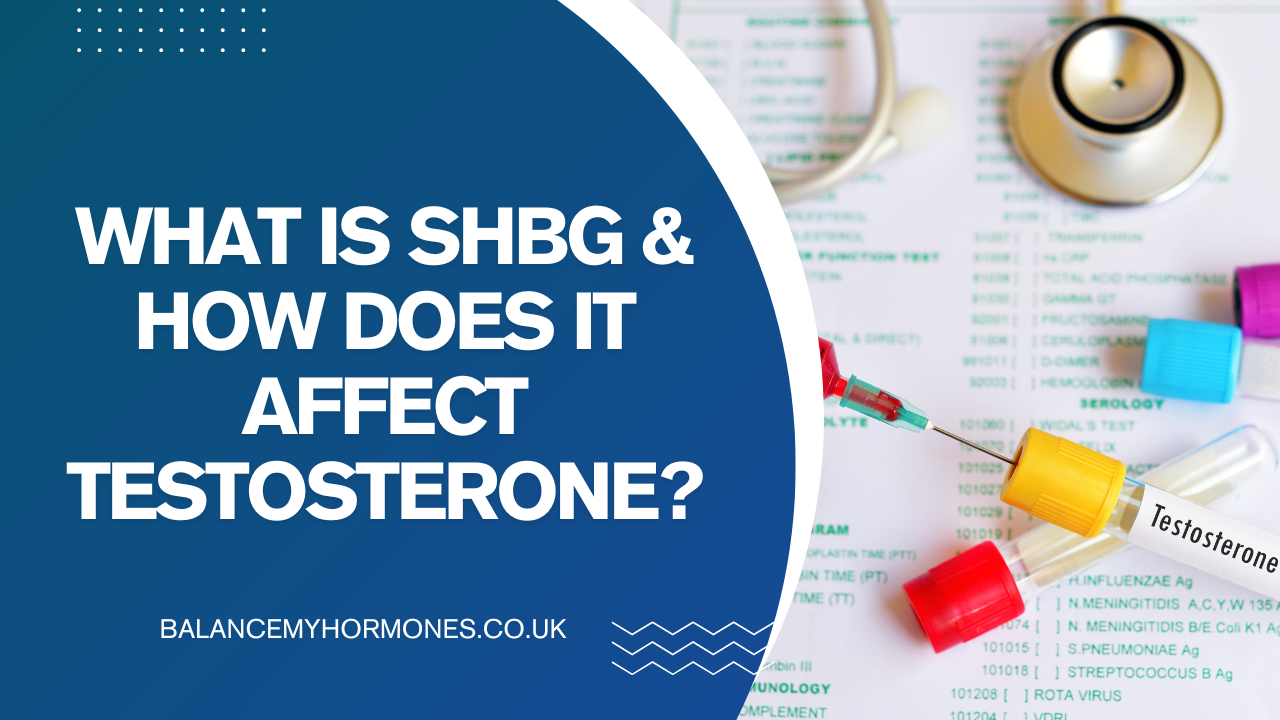
Sex hormone-binding globulin (SHBG) is a transport protein that binds to sex hormones, particularly testosterone, and allows them to circulate safely in the bloodstream.
Testosterone that’s attached to SHBG is called bound/unavailable testosterone, while testosterone that’s not attached to SHBG is called free or biologically active testosterone.
Because only free testosterone can enter cells and exert its effects, changes in levels of SHBG can influence testosterone hormone activity.
This article explains everything about sex hormone-binding globulin and how it impacts testosterone levels.
What is SHBG?
SHBG is a large glycoprotein that consists of two identical subunits. The liver produces SHBG, and its secretion is regulated by sex steroids (testosterone, oestrogen, DHT), as well as other hormones and some metabolic factors.
According to data, the biological half-life of SHBG is approximately 7 days.
This means it takes roughly a week for half of it to be cleared from the bloodstream. Because of this gradual turnover, SHBG levels do not change rapidly. Instead, they reflect the body’s hormonal and metabolic state over the past several days rather than immediate fluctuations.
What does SHBG do?
SHBG’s primary role is to bind to sex hormones, mainly DHT, testosterone and oestrogen. In this way, it controls their biological availability to cells and protects them from rapid metabolism/clearance.
Studies show that the binding affinity of SHBG is in this order: DHT > testosterone > oestrogen.
Around 70% of the total testosterone is bound to SHBG, 20% to 30% is weakly bound to albumin protein, and only 1% to 2% is freely available. However, these percentages can vary from person to person.
Normal SHBG range
SHBG levels can vary depending on your age, hormone levels, and overall health condition. Normal reference ranges for SHBG in men and women are:
| Male | 13 – 71 mmol/L |
| Female | 18 – 114 mmol/L |
High SHBG
High SHBG means your liver cells are synthesising more SHBG than needed.
What happens if your SHBG is high?
High SHBG can reduce the amount of free/bioavailable testosterone and oestrogen, which may lead to associated symptoms despite normal total hormone levels.
Here are the common symptoms of high SHBG in men:
- Low libido (sex drive)
- Loss of muscle mass and bone density
- Erectile dysfunction (ED)
- Reduced energy levels
- Increased body fat
- Irritability
Women may experience the following high SHBG signs:
- Menstrual irregularities
- Vaginal dryness
- Reduced libido or sexual function
- Loss of muscle mass
- Mood changes
- Hair loss and skin changes
Large population studies show that higher levels of circulating SHBG are associated with a lower risk of coronary heart disease in both men and women. However, more research is needed before SHBG can be used reliably as a clinical marker to predict heart disease risk.
What causes high SHBG?
Sometimes, high SHBG can happen as a normal regulatory response to changes in hormone levels, especially increased oestrogen or reduced androgen activity.
In other cases, it may be associated with medical conditions such as:
- Thyroid disorders like hyperthyroidism (overactive thyroid)
- Anorexia (eating disorder)
- Severe calorie restriction
- Liver disease
- Ageing
- Use of certain medications (oestrogen-containing medicines like those used in hormone replacement therapy and anti-epileptic drugs)
- Low growth hormone levels
- Low androgen activity
How to lower SHBG?
You can lower SHBG by treating its underlying cause. For instance, if it’s due to insulin resistance, then improving insulin sensitivity may help.
Similarly, if your high SHBG is due to chronic dieting or very low body fat, increasing body weight or reducing calorie deficit may also improve your SHBG levels.
Is high SHBG good or bad for men?
High SHBG level is definitely bad for men as it can reduce the amount of free testosterone in blood and cause unwanted low T symptoms.
Low SHBG
When the liver fails to produce enough SHBG, which is required for normal functioning, then SHBG levels fall.
What happens if your SHBG is low?
People with decreased SHBG levels may experience symptoms associated with high testosterone or other sex hormone.
Men with low SHBG levels may have these problems:
- Increase in muscle mass
- Weight gain
- Acne
- Fluid retention
- Voice deepening
- Increase in breast size
Low SHBG signs in women include:
- Reproductive health issues like infertility
- Deepening of voice
- Weight gain
- Irregular periods
- Excess facial and body hair growth
- Breast tenderness
What causes low SHBG?
Low levels of SHBG can happen due to multiple reasons, such as:
- Obesity
- Type 2 diabetes mellitus
- Thyroid hormones issues like hypothyroidism (underactive thyroid)
- Non-alcoholic fatty liver disease
- Hypercaloric diets
- High growth hormone levels
- High insulin levels
- Cushing’s syndrome
- Androgen steroid use
- Polycystic ovarian syndrome (PCOS in women)
How to increase SHBG?
You can increase SHBG by treating its root cause. Studies show that losing weight, exercising regularly, and having a diet rich in fibre and low in sugar may help elevate SHBG levels.
Can low SHBG cause ED?
Yes, low SHBG can contribute to erectile dysfunction by increasing free oestrogen levels. This shift in the androgen-to-oestrogen balance can suppress androgen receptor activity, which is required for normal erectile response.
How does SHBG affect testosterone?
SHBG regulates the bioavailability of testosterone. Most of the testosterone in the blood forms hydrogen bonds with SHBG and becomes inactive. This bound testosterone can neither enter cells nor be readily degraded in blood.
Bound testosterone becomes free through reversible dissociation from SHBG, driven by normal equilibrium dynamics. Free testosterone is biologically active and is taken up by tissues for usage.
Abnormal SHBG levels can impact free testosterone levels.
High SHBG can lock in more testosterone, reducing free testosterone concentrations despite normal total testosterone levels. Conversely, low SHBG may cause elevated free testosterone levels.
Two men can have the same total testosterone, but one may feel normal while the other may have symptoms. This is because differences in SHBG levels affect how much testosterone is free and biologically active.
For this reason, doctors measure both total testosterone and SHBG to get a more accurate picture of hormonal health and avoid misdiagnosis.
Monitoring SHBG on TRT
Men on testosterone replacement therapy (TRT) need to carefully evaluate their SHBG levels as well. Because SHBG affects how testosterone behaves in the body, so treatment needs to be adjusted accordingly.
If SHBG is high, more administered testosterone will bind to SHBG and become unavailable. In this case, your TRT provider will focus on increasing free testosterone while keeping total levels within the healthy range.
Similarly, if your SHBG is low, more of the administered testosterone may become readily available for usage, which can lead to unwanted hormonal fluctuations. In such cases, smaller but more frequent testosterone doses may be given for hormonal balance.
Two men taking the same dose of testosterone can have very different results because of having different SHBG levels.
Hence, make sure you get your SHBG levels checked regularly alongside free and total testosterone for optimal results.
How does TRT affect SHBG levels?
TRT generally suppresses SHBG production by the liver. However, studies show that it does not affect everyone the same way. TRT’s impact on SHBG depends largely on a man’s age, baseline SHBG levels, TRT method, dosage, and other individual factors.
For instance, injectable testosterone mostly affects SHBG levels more profoundly compared to transdermal testosterone (testosterone gels and creams).
This is because testosterone injections produce higher peaks of circulating testosterone. On the other hand, transdermal testosterone preparations deliver more stable hormone levels and therefore exert a less pronounced effect.
Monitoring SHBG levels throughout TRT is the most reliable way to track your SHBG levels.
What is the normal range for SHBG on TRT?
On TRT, SHBG is mostly lower than baseline. However, it should still be within the standard reference range of 13–71 mmol/L for men.
SHBG blood test
An SHBG blood test is used to measure SHBG levels in the blood. If your doctor suspects your symptoms may be due to testosterone deficiency, they will usually start by asking you to order a basic testosterone test which also performs an SHBG blood test as one of the test biomarkers.
If the results are borderline or do not match your symptoms, SHBG levels are then measured to assess how much testosterone is actually free and biologically active.
How to calculate free testosterone from total testosterone and SHBG?
You can calculate free testosterone concentration using different methods. However, Vermeulen Equation is the most widely used and clinically accurate approach.
A simpler but less accurate method is the Free Androgen Index (FAI), which is calculated as:
FAI = (Total Testosterone ÷ SHBG) × 100
FAI gives an approximate value, not exact.
Online free testosterone calculators use these validated equations to estimate free testosterone more easily. Use our online calculator to measure your free testosterone based on albumin, total testosterone, and SHBG levels.
Summary
Sex hormone binding globulin (SHBG) is an important protein whose levels directly influence serum free testosterone levels. High SHBG locks in more testosterone and reduces bioavailable testosterone levels despite normal total testosterone. On the other hand, low SHBG tends to cause high free testosterone.
Your SHBG levels can fluctuate due to ageing, use of certain medications, and an underlying health problem. A healthy lifestyle can help prevent many of these issues and keep you well.
If you suspect SHBG abnormality, consult with a medical professional and get an SHBG lab test done. Proper evaluation and timely management can prevent problem escalation and restore hormonal balance.
At BMH, we provide effective solutions to men with low testosterone levels, helping improve their hormone levels and overall health. Book your free consultation today to learn everything about your testosterone levels and bring them back within the healthy range.
References
Ramachandran, S., Hackett, G.I. and Strange, R.C., 2020. Testosterone replacement therapy: pre‐treatment sex hormone‐binding globulin levels and age may identify clinical subgroups. Andrology, 8(5), pp.1222-1232.
Li, J., Zheng, L., Chan, K.H.K., Zou, X., Zhang, J., Liu, J., Zhong, Q., Madsen, T.E., Wu, W.C., Manson, J.E. and Yu, X., 2023. Sex hormone-binding globulin and risk of coronary heart disease in men and women. Clinical chemistry, 69(4), pp.374-385.
Mean, F., Pellaton, M. and Magrini, G., 1977. Study on the binding of dihydrotestosterone, testosterone and oestradiol with sex hormone binding globulin. Clinica Chimica Acta, 80(1), pp.171-180.
Evidence Based Research
This article has been researched and written based on scientific evidence and fact sheets that have then been crossed checked by our team of doctors and subject matter experts.
References, sources and studies used alongside our own in-house research have been cited below, most of which contain external clickable links to reviewed scientific paper that contain date stamped evidence.
Our team of healthcare experts and GMC registered doctors are licensed to UK GMC standards. We strive to provide you with the latest evidence based, researched articles that are unbiased, honest and provide you with accurate insights, statistics and helpful information on the discussed topic to ensure you gain a better understanding of the subject. You can read more about our Editorial Process by clicking here.
We value your feedback on our articles, if you have a well-researched paper you would like to share with us please contact us.
Quick Low Testosterone Test
If you know your total testosterone reading from a previous blood test input the results to the left above to see if your testosterone levels are normal.
Low Testosterone Levels
You may have low testosterone depending on the symptoms you have, please contact us to find out how we can help.
Please Retry
The Total Testosterone Level You Entered Is Incorrect. Figure Must be in nmol/L you can use our converter here.
Normal Testosterone Levels
Your testosterone levels appear to be in the normal range.
LOOKING GOOD!
You must be over 38, have had your ovaries removed or have suffered with premature menopause to warrant further hormone tests.
Further investigation needed
Please contact us to discuss your hormones, we need your total testosterone levels to validate your hormone deficiency. You can order a blood test here.
Low Testosterone Levels
You may have low testosterone depending on the symptoms you have, please contact us to find out how we can help.
High Testosterone Levels
You appear to have higher than normal testosterone levels, please contact us for further investigation.
Normal Testosterone Levels
You appear to have normal testosterone levels. Contact us if you have any concerns.
About the Author: Mike Kocsis
 Mike Kocsis has an MBA with a focus on healthcare administration and is an entrepreneur and medical case manager for Balance My Hormones which offers medical services in the UK and Europe. Mike has over 25 years of experience in the healthcare sector, much of that working with people who have hormone imbalances. Mike has appeared on podcasts and radio and is an expert speaker on the subject of hormone imbalance. He specialises in Testosterone Replacement Therapy and Hormone Replacement Therapy (HRT) and with his first-hand experience he has helped thousands of people suffering from low testosterone recover and regain control of their lives. You can follow him on LinkedIn and on the Balance My Hormones YouTube Channel.
Last update: May 6th, 2026